
|
General Product Application The Telebyte Model 456 Loop Interference Simulator generates narrow and broadband noise of various shapes. These can then be introduced into a two-wire transmission path between two modems. By adjusting the level of noise power relative to modem signal power levels, the effect of the impairment can be controlled. For different signal-to-noise level settings, data such as error rate can be measured and recorded. The performance of the modems can then be evaluated and optimized. Depending on the type of modem, a noise shape is selected that would result in interference in the band of the modems' operation. This product has a variety of noise shapes to select from. Refer to the manual for a detailed theory of operation. Bit Error rate MeasurementsFigure 1 illustrates a simplified typical configuration used for making error-rate measurements. Two modems are connected to each other using a two-wire line simulator Note 1. The simulator can be set for various lengths, depending on the nature of the tests. This is beyond the scope of this document. Typically the longer the length of the line, the higher the tendency for bit errors, since longer lines result in a lower level of received signal. A BERT (Bit Error Rate Test) Set at each end generates a unique data test pattern for transmission towards the opposite end and detects and displays errors of the received data. The noise source must be injected at the junction of the modem and the two-wire line simulator without disturbing modem signal levels. This is accomplished by using a noise generator having a high-impedance (current source) output. In order to set up signal-to-noise ratios so error-rate data can be recorded, the signal and the noise must be measured independently. The Telebyte Model 456 Loop Interference Simulator accomplishes all of these tasks.  Note 1: In some cases it may be desired to use two line simulators so that noise can be inserted in the center between the simulators thus simulating a symmetrical network. Telebyte's series of Wire Line Simulators - Model 454, 455, and the 457 - are ideal for this type of testing. Figure 2 illustrates a block diagram of the Model 456 Loop Interference Simulator. The theory of the internal operation is explained in the reference manual. The controls and connections function as follows (refer to Figure 2 for each step):
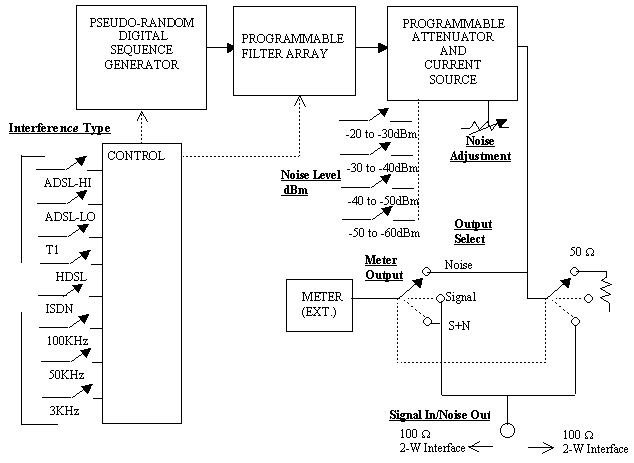 Figure 3 illustrates the actual connections of the test setup corresponding to steps' a through e. 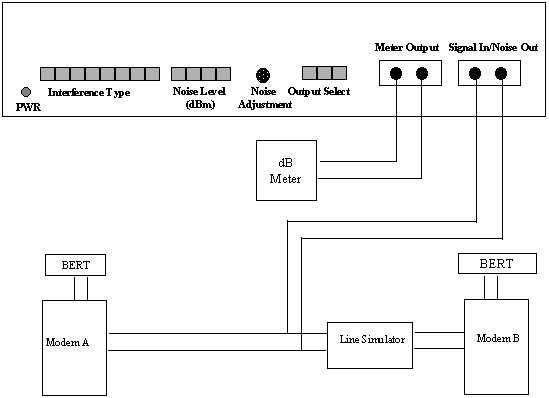 IMPORTANT NOTE ON OBTAINING CONSISTENT RESULTS It is important to recognize that when making signal-to-noise (S/N) ratio error-rate measurements, the same equipment must be used for making "A" versus "B" comparisons of modems or changes in modem designs. This means that the test equipment, which includes the model 456, the dB meters used for signal and noise level measurement etc., should not be the variable when making comparisons. To carry this a step further, one should not compare error rate measurements using another manufacturers' noise source to measurements made using the Telebyte Model 456, for the same modems. The reason for this is that no two noise sources are identical unless the exact same circuitry is used for noise generation and shape approximations, and this is rarely the case. Finally, in making "A" vs "B" comparisons, tests should always be performed under the same environmental conditions. NOISE SPECTRUMSThere are two basic families of noise shapes. The first category is Flat Noise, which in the Model 456 case covers 300Hz to 3KHz, 5KHz to 50KHz and 10KHz to 100KHz. The purpose of this category is to simulate band-limited white noise, which is characteristically flat over the band of interest. Typical sources may be thermal noise, resistor noise or other similar random noise sources. The second category is shaped noise. Such noise sources simulate the effect of cross-talk from various types of signals within 50-pair cables that are typically used for local-loop transmissions. There are typically two types of cross-talk signals, Near-End (NEXT) and Far End (FEXT) and from 10 or 49 "disturbers". A single "disturber" is another pair of wires in the same cable containing the interfering signal so 49 disturbers would be 49 cable-pairs generating cross-talk simultaneously. Near End means that the cross-talk under simulation occurs at the near end of the circuit and Far End means that the cross-talk occurs at the far end of the circuit. We will now discuss each noise shape. Flat 3KHz, 50KHz and 100KHzThese three shapes simulate white (flat) noise over three different bands and can result from sources such as thermal noise or resistor noise. 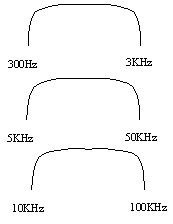 ISDN 2B1Q This shape is defined by ANSI T1.601 and represents the composite near-end interfering signal resulting from 49 disturbers each containing a 2B1Q ISDN modem signal. Most of the energy is concentrated between 50KHz and 75KHz with a gradual roll-off below 50KHz and a fairly steep roll-off above 75KHz. A secondary lobe of spectral energy occurs between 160KHz and 320KHz. 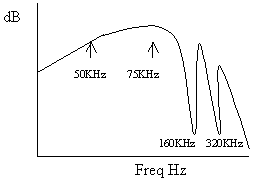 HDSL This response simulates the near-end cross-talk (NEXT) resulting from 10 disturbers per the ANSI T1.E1.4 specification. Each of the disturbers contains an HDSL modem signal. The concentration of energy is around 150Khz with a gradual roll-off below 100KHz and a steeper roll-off starting at 200KHz with a spectral null at approximately 400KHz. 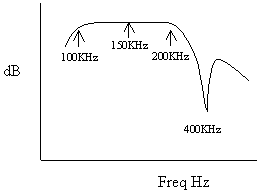 T1 The T1 spectral simulation represents a relatively broadband spectrum resulting from near-end cross-talk (NEXT) from 20 disturbers each containing a T1 signal. 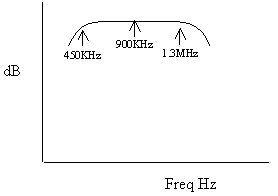 ADSL -LO The ADSL-LO spectrum represents the near-end (NEXT) cross-talk resulting from 10 disturbers per T1.E1.4. where each disturber contains an ADSL signal. Since the near-end utilizes an upstream-signal which is contained in the lower frequency range of the band the coupled (cross-talk) signal falls mainly between 30KHz and 140KHz. 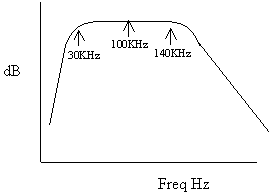 ADSL-HI The ADSL-HI spectrum represents the far-end (FEXT) cross-talk resulting from 10 disturbers per T1.E1.4. where each disturber contains an ADSL signal. Since the far-end utilizes a downstream-signal which is contained in the upper frequency range of the band, the coupled (cross-talk) signal extends beyond 1 MHz. 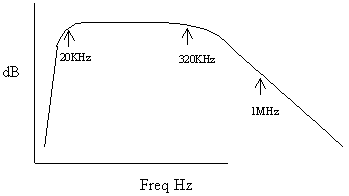 |
| Model | Product Info |
|---|---|
| 454 |


|
| 455 |
|
| 456 |
|
| 457 |
|
