
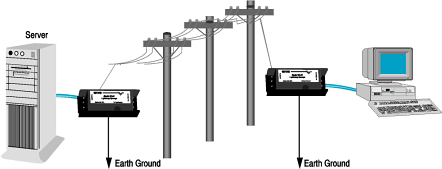
 Lightning has long fascinated the technical community. Ben Franklin studied lightning's electrical nature over 2 centuries ago and Charles P. Steinmetz generated artificial lightning in his General Electric laboratory in the 1920's. Anyone concerned with premises data communications needs to worry about lightning. Few worry enough! High voltage transients caused by lightning and other electrical disturbances have the easy ability to destroy semiconductor junctions and thus cause equipment failure. A lightning strike in the vicinity of data lines can cause induced ground currents that can also do serious damage. However, coming right down to it, a lot can be done as far as protection is concerned. In particular, typical leading edge wave-fronts of a lightning strike rise at the rate of 1,000 Volts per microsecond. Adequate protection from this particular lightning threat can be provided by the Model 22-64 Lightning Sponge. The Model 22-64 Lightning Sponge provides protection for 4 independent data communications circuits, each operating at a rate up to 64 KBPS and each possibly exposed to such lightning induced transients. The protection provided by the Model 22-64 Lightning Sponge is particularly robust. The protection circuitry incorporates 3 separate stages for limiting high voltage lightning transients. These stages are respectively realized from gas tubes, avalanche diodes and MOV thyristers. Each is matched to a different rise time and surge level. In particular, the first stage of protection, the first line of defense, the gas tube, is capable of accommodating 1,000 A. It would be a good idea to have a Model 22-64 installed on each end of the 4 wire transmission line for short haul modems or RS-232 devices found in the premises data communication environment. The illustration above shows the Model 22-64 in a typical application. Notice the designations of 'Earth Ground.' This unit and other similar lightning sponges operate by directing lightning induced currents to 'Earth Ground.' It is important that the Model 22 be grounded properly. This should be done with a wire which is, at least, 12 AWG. Connection to cold water pipes probably provides the best ground. However, make sure that they are metal not plastic. Connection to a plastic pipe doesn't help. Also beware of connecting to a ground stud in a wall which, itself, is not connected to Earth Ground. |
| Model | Product Info |
|---|---|
| 22-64 |


|
